
How to Choose the Right Events for Your Food Truck
Big crowds don’t guarantee big profits. Learn how to identify the events that are truly worth your food truck’s time and money.
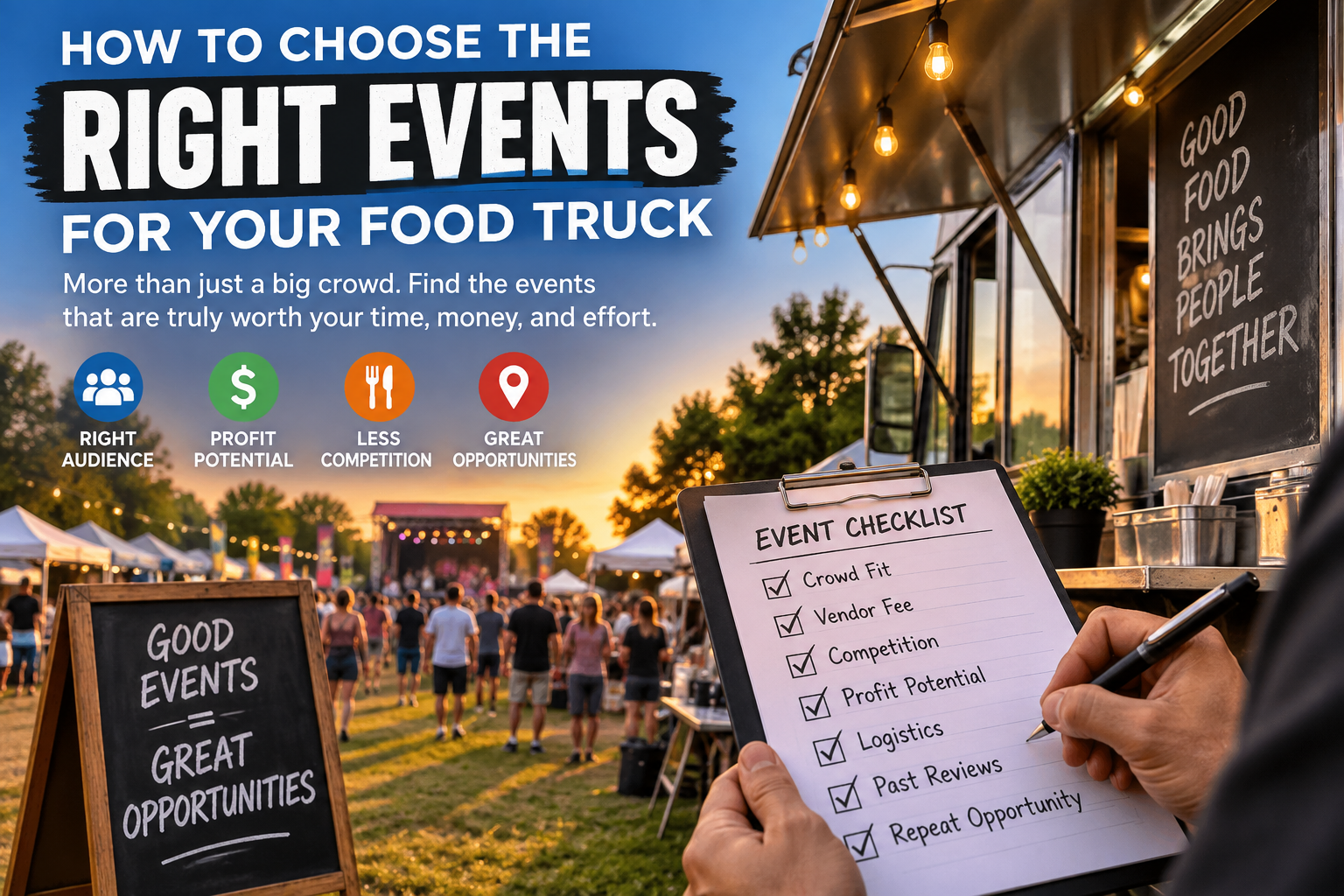
Festivals, fairs, concerts, sporting events, and community gatherings can produce some of the best sales days of the year for a food truck. But they can also leave you with high vendor fees, extra labor costs, leftover food, and a long drive home wondering whether the event was worth it.
The key isn't getting into more events.
It's getting into the right events.
Before committing your food truck to your next event, here are some of the most important things to consider.
1. Don't Judge an Event by Attendance Alone
"10,000 people expected!”
That sounds great—but attendance numbers don't tell the whole story.
If 10,000 people attend and there are 50 food vendors, that's a very different opportunity from an event with 5,000 attendees and only 10 food vendors.
Ask the organizer:
- How many people attended last year?
- How many food vendors are being accepted?
- How long does the event last?
- Is admission free or ticketed?
- Are attendees allowed to bring outside food?
- Are there restaurants or permanent concessions nearby?
You're trying to determine how much actual buying opportunity exists—not simply how many people will walk through the gate.
2. Make Sure the Crowd Fits Your Concept
The right customers matter more than the biggest crowd.
Think about what you sell and who typically buys it.
A truck specializing in quick lunch items might perform differently at a corporate event than at an all-day music festival. A dessert or beverage truck may perform especially well at family events, fairs, and summer festivals.
Ask yourself:
“Would the people attending this event normally buy what we sell?”
If the answer isn't clear, investigate before paying the vendor fee.
3. Find Out Who Else Is Serving Food
Competition isn't necessarily bad. A large event needs multiple food vendors.
But you don't want to arrive and discover six other trucks selling nearly the same thing.
Ask organizers for the expected food vendor lineup.
If you're the only Thai truck, BBQ truck, loaded potato truck, specialty drink truck, or other distinctive concept, you may have an advantage.
You should also look at whether the event has permanent concessions, restaurants, or inexpensive food options nearby.
4. Look Closely at the Vendor Fee
An event can generate impressive sales and still be a poor business decision.
Suppose you sell $3,500 during an event.
That sounds successful.
But then subtract:
- Vendor fee
- Food costs
- Employee wages
- Fuel
- Travel expenses
- Additional supplies
- Payment processing
- Unsold inventory
Suddenly that $3,500 looks very different.
Some events charge a flat vendor fee, while others may charge a percentage of sales or use another arrangement.
Know exactly what you're agreeing to before booking.
The question isn't:
“How much can we sell?”
It's:
“How much can we keep?”
5. Consider the Hours
Don't overlook how long you'll actually be committed to the event.
A six-hour festival may really mean:
2 hours preparing + 1 hour traveling + 1 hour setting up + 6 hours serving + 1 hour cleaning + 1 hour driving home.
Your six-hour event just became a 12-hour day.
That's why sales per hour can be useful when comparing events.
An event generating $2,000 during a short, intense service period could potentially be more attractive than one generating $3,000 while consuming your entire day.
Your time has value too.
6. Ask About Power, Water, Parking, and Setup
Operational details can make or break an event.
Before arriving, find out:
- Is electricity available?
- What amperage/service is provided?
- Do you need your generator?
- Is potable water available?
- Where will trucks park?
- How early must you arrive?
- Can you leave when you sell out?
- Is overnight parking required?
- How close can supply vehicles get?
- Are there restrictions on generators or propane?
A profitable-looking event can quickly become frustrating if the setup doesn't work for your truck.
7. Think About Weather Risk
Food trucks are especially vulnerable to weather.
Extreme heat, heavy rain, storms, or cold temperatures can dramatically affect attendance.
Before paying a large non-refundable vendor fee, understand the event's cancellation and weather policies.
Ask what happens if the event is canceled.
Does your fee roll over to another event?
Is any portion refundable?
Does the event continue rain or shine?
The larger the upfront investment, the more important these questions become.
8. Look at the event's history.
Established events give you extremely valuable data.
Search for previous years on social media.
Look at photos and videos.
Was the event actually crowded?
Were food trucks busy?
What kinds of people attended?
You can also talk to other food truck owners.
A five-minute conversation with someone who attended last year may tell you more than a promotional packet from the organizer.
9. Don't Forget Repeat Opportunities
Some events provide value beyond one day's sales.
A corporate event could lead to catering opportunities.
A brewery festival could introduce you to a venue that later books your truck regularly.
A community event might expose your business to hundreds of local customers who begin following your truck afterward.
That's another reason branding and customer engagement matter.
Encourage customers to follow your business, visit your website, or use your online ordering and loyalty options.
You want the relationship to continue after the event ends.
10. Track Every Event
Once you've attended an event, record what happened.
Don't rely on memory three months later.
Track things like:
Total sales
How much did the truck generate?
Number of orders
How many transactions did you process?
Average ticket
How much did the typical customer spend?
Sales by hour
When were you busiest?
Best-selling items
What worked with this particular crowd?
Total event cost
What did you spend to participate?
Would you return?
Was the event worth doing again?
This is where your POS can become a business tool instead of simply a cash register.
With SimonPOS reporting, food truck operators can track sales and performance and use that information to make better decisions about locations and events.
Instead of saying:
“I think we did pretty good there last year.”
You want to be able to say:
“Here's exactly how that event performed.”
Build Your Own Event Scorecard
After every event, give it a simple rating based on:
Sales • Profit Potential • Customer Fit • Vendor Fee • Competition • Sales Per Hour • Operational Difficulty • Repeat Potential
Over time, you'll build your own database of events.
You'll learn which festivals are worth returning to, which ones aren't, and what types of events consistently work best for your particular food truck.
That's much more valuable than simply following the biggest crowds.
Choose Events Based on Business, Not Hype
A packed festival can look impressive on social media.
That doesn't automatically make it a great event for your food truck.
The right event combines the right customers, reasonable fees, manageable competition, strong sales potential, and an operation your team can handle efficiently.
Ask questions before committing.
Know your costs.
Track your results.
And use what you learn to make next year's schedule better than this year's.
Make Better Decisions With SimonPOS
SimonPOS is being built specifically around food trucks and mobile eateries, including reporting and location-based tools that can help operators understand how their business performs at different locations and events.
Track sales, order counts, average tickets, tips, and location performance so you're not choosing next season's events based entirely on memory.
The goal isn't to attend every event. It's to know which events deserve a spot on your calendar.
Run smarter. Choose smarter. Grow with SimonPOS.