
How to Start a Food Truck Business: The Operator-First Checklist for 2026
Learn how to start a food truck business by validating your menu, permit path, break-even volume, vehicle requirements, and service capacity before making a major investment.
Quick Answer
To start a food truck business, validate your menu and selling locations before buying a vehicle. Confirm the local permit path, calculate your break-even orders, and make sure the kitchen can serve that volume. Then select the vehicle, complete approvals, install your operating systems, and run a measured soft launch.
Starting a food truck business is not simply a matter of buying a vehicle, installing equipment, and finding somewhere to park. Your menu, permits, kitchen capacity, selling locations, and financial model must support one another.
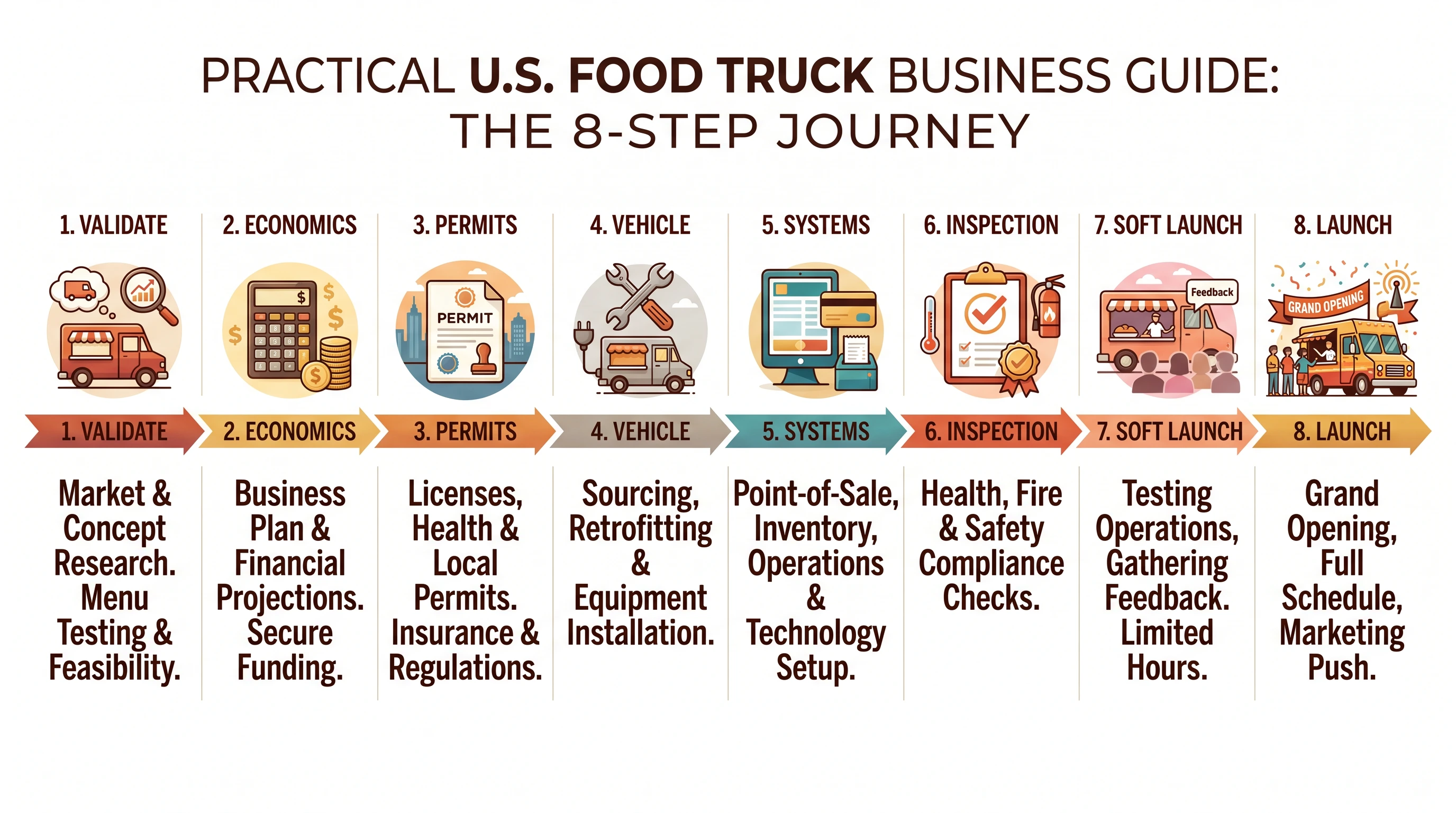
The safest sequence is:
Validate → calculate → confirm permits → choose the vehicle → build systems → inspect → test → launch
SimonPOS was founded from firsthand food truck operating experience. The practical lesson behind this food truck startup checklist is simple: do not buy the truck until the permit path, unit economics, and required service capacity agree.
What should you confirm before buying a food truck?
Start with the service you want to operate, not the vehicle you want to own.
Define your intended customer, location, and service window. An office-lunch stop with 90 minutes of demand is different from a four-hour brewery service, a weekend festival, or a private catering job.
Test a focused version of your menu through a locally permitted option, such as a market stall, shared kitchen, catered event, pop-up, rental unit, or partnership with an existing operator.
Use the test to answer practical questions:
- Which items do customers actually buy?
- What average ticket can you produce?
- How long does each order take?
- Which station creates the longest delay?
- How much food is wasted?
- Can the team handle a rush without errors?
- Will customers pay the price your costs require?
A successful taste test does not prove that the business works. The menu must also fit your storage, equipment, labor, and service window.
For each item, identify its prep location, cooking method, equipment, holding requirements, packaging, storage, and target ticket time. Remove items that create more complexity than value.
How much does it cost to start a food truck business?
There is no dependable national average for food truck startup costs. A used trailer with a simple menu cannot be meaningfully compared with a new custom truck containing fryers, refrigeration, ventilation, and its own power system.
Build your budget from dated local quotes for:
- Truck, trailer, cart, or rental
- Mechanical inspection and repairs
- Kitchen construction and equipment
- Ventilation and fire suppression
- Electrical, generator, battery, or shore power
- Propane, water, and wastewater systems
- Plan review, permits, and inspections
- Commissary or shared-kitchen access
- Insurance and vehicle registration
- Ingredients, packaging, and smallwares
- POS, payment hardware, printer, or kitchen display
- Payroll, fuel, event deposits, and opening cash
- Contingency and working capital
Compare several operating formats when possible. A cheaper vehicle can become the more expensive choice after repairs, towing equipment, code upgrades, and missed service days.
How do you calculate break-even orders?
Contribution per order is the money left after costs that increase with each sale, such as food, packaging, and payment expenses.
Use these formulas:
Average ticket − variable cost per order = contribution per order
Service costs ÷ contribution per order = break-even orders
Consider this hypothetical service:
- Average ticket: $15
- Food and packaging: $4.50 per order
- Payment and other variable costs: $0.75 per order
- Contribution per order: $9.75
- Service costs excluding owner pay: $700
The truck needs approximately 72 orders to cover those costs:
$700 ÷ $9.75 = 71.8, rounded up to 72 orders
That equals $1,080 in sales. To add $200 in owner compensation, the target rises to 93 orders, or $1,395 in sales.
Now compare that target with the kitchen’s capacity. If the team can produce only 24 orders an hour during a three-hour window, its theoretical maximum is 72 orders. The proposed service would barely cover expenses and would not reach the owner-pay target.
You would need a higher average ticket, better margin, lower service cost, faster production, longer selling window, or stronger location.
What permits and approvals does a food truck need?
Food trucks are generally regulated by state and local authorities. The FDA Food Code provides a model for regulators, but it is not automatically the controlling law in every jurisdiction.
Contact the agencies responsible for every place where you will prepare food, store the vehicle, sell, park, or dispose of waste. Your list may include:
- State or local health department
- City and county licensing offices
- Fire authority
- Zoning and parking offices
- State business-registration agency
- State and local revenue departments
- Motor-vehicle department
- Commissary or shared-kitchen operator
- Event organizer or property owner
Ask whether plan review is required before buying equipment or modifying the vehicle. Also ask whether a commissary is required, which code edition is enforced, which approvals must come first, and whether existing approvals transfer when a used vehicle is sold.
A practical approval sequence is:
- Define the menu and preparation process.
- Identify every jurisdiction where you plan to operate.
- Confirm commissary and plan-review requirements.
- Review the equipment with health and fire authorities.
- Purchase or modify the vehicle.
- Complete inspections.
- Obtain operating and location-specific permits.
- Record renewal dates.
Save application documents, fees, expiration dates, official links, and important answers in one permit file. Recheck requirements before accepting work in another city or county.
As of August 18, 2026, FinCEN states that entities created in the United States are exempt from federal beneficial ownership information reporting under its current rule. Older resources may contain outdated instructions, so verify FinCEN’s guidance before relying on them.
Legal information last reviewed: August 18, 2026
Next review due: November 18, 2026
Should you buy a truck, trailer, cart, or rental?
Choose the format based on your menu, route, utilities, parking, maintenance plan, and local requirements.
Food truck
A self-propelled truck can make frequent location changes easier. However, an engine or transmission problem can take both the vehicle and kitchen out of service.
Have the commercial kitchen and vehicle inspected separately before purchasing.
Food trailer
A trailer separates the kitchen from the tow vehicle and may provide more usable workspace for the purchase price. It also requires a properly rated tow vehicle, storage space, towing experience, and room to maneuver.
Include the tow vehicle and hitching equipment in your total cost.
Food cart
A cart may work for a compact menu with limited equipment. Its storage, refrigeration, water, cooking, and weather protection can be restrictive.
Confirm cart rules separately rather than assuming they match food truck requirements.
Rental
A rental can reduce the commitment required for a market test, seasonal service, or temporary replacement. Tradeoffs may include higher monthly costs, limited availability, and equipment that does not perfectly match your menu.
Confirm who handles maintenance, insurance, permitting, storage, and damage.
How should you set up the kitchen and POS?
Design the kitchen around the order’s movement from payment to pickup:
- The customer places and pays for the order.
- The ticket reaches the correct stations.
- Food moves through cooking and assembly.
- The completed order is checked.
- The customer is notified.
- The order reaches the pickup window.
Look for employees crossing paths, waiting for the same work surface, or blocking the service window. The kitchen must sustain your break-even order volume without unsafe shortcuts.
Verify power, ventilation, water, wastewater, refrigeration, equipment attachment, and fire-suppression requirements with your reviewing authorities.
What should a food truck POS handle?
A food truck POS system should work in a small space, during a rush, and when connectivity is unreliable.
Test:
- Cash, cards, and digital wallets
- Modifiers and sold-out items
- Printed tickets or a kitchen display
- Tips, discounts, refunds, and voids
- Weak-signal and backup-connectivity procedures
- Online and walk-up orders arriving together
- End-of-day reconciliation
A kiosk can speed up ordering, but it does not increase cooking capacity. If the kitchen can make only 25 orders an hour, faster ordering may simply create a longer ticket queue.
Mobile businesses also need to keep menus, hours, pickup instructions, and locations synchronized. SimonPOS provides a POS built for mobile eateries, including location-based reporting and connected customer tools. Owners can start with a free food truck POS and add managed services when needed.
What should you measure during a soft launch?
Before inviting customers, complete a full rehearsal. Load the vehicle, drive the route, set up, prepare representative orders, simulate a rush, process a refund, close, clean, reconcile payments, and return to your commissary or storage location.
During the soft launch, record:
- Orders per hour
- Average ticket
- Contribution per order
- Typical and longest ticket times
- Order errors and refunds
- Waste and stockouts
- Sales by item
- Setup and closing time
- Customer questions and complaints
Fix the largest bottleneck before adding menu items or spending more on marketing.
For the first 30 days, review every service separately. Track sales, orders, labor, event fees, travel, waste, owner hours, and contribution by address or event.
Ask which locations deserve a return visit, which menu items slow the line, and whether the business is producing acceptable owner compensation. Location-based reporting can help separate profitable stops from busy-looking but expensive events.
Do not scale based on one crowded service. Add locations, staff, menu items, or another vehicle only after the original operation can produce repeatable results.